- A
- A
- A
By Bruce Darling, President/CEO of the Center for Disability Rights/Regional Center for Independent Living
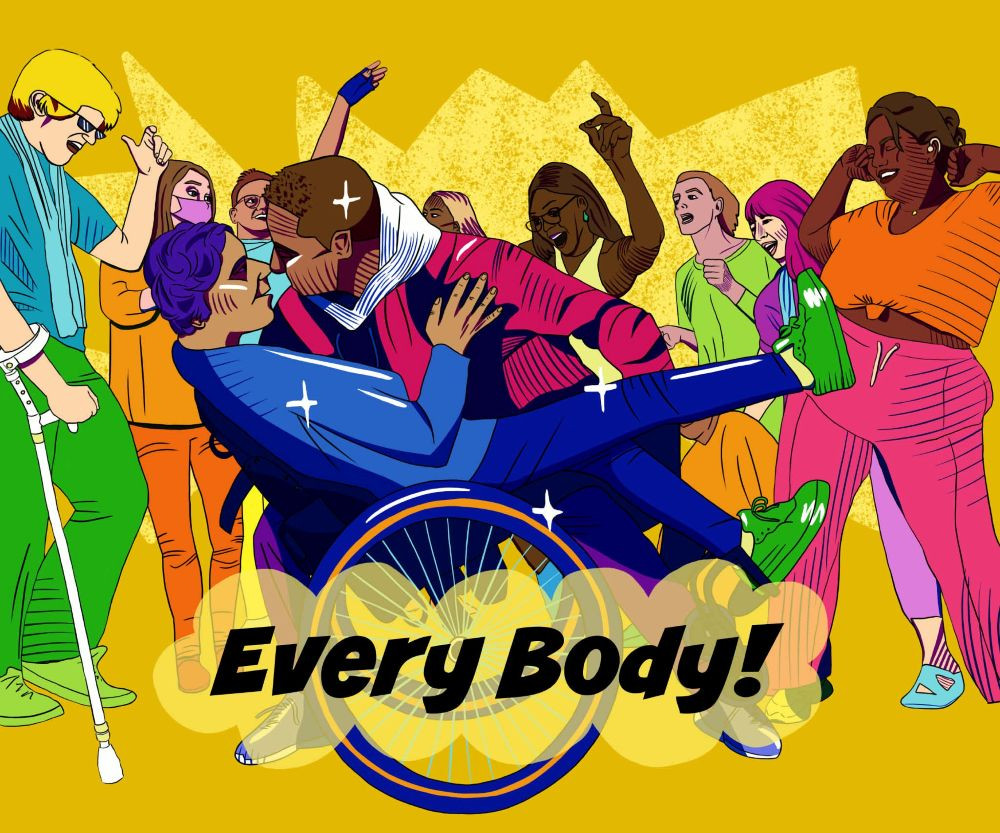
On Saturday, CDR unveiled three banners — each ten feet by twelve feet — on the front of our building at 497 State Street. They are brightly colored, joyful, and impossible to miss, and that is exactly the point.
I’ll be honest with you: this one is personal for me.
As someone who lives at the intersection of Disability and Queer identity, I have spent a long time in two communities that don’t always see each other clearly. And I have noticed something that I think a lot of us feel but don’t always say out loud: Pride hits differently depending on which of these communities you’re in. In LGBTQAI+ spaces, Pride is often celebration — exuberant, festive, a party. In Disability community, pride is something a bit different — pride as a counter to pity and pride as the simple insistence that our lives are worth living. Both are real. Both are true. And for those of us who belong to both communities, Pride is all of that at once. That’s what these banners are about.
What you see on State Street
“Every Body!” — Against a golden, spotlit background, a crowd of LGBTQ+ people with disabilities dance together. At the center, two men share a romantic dip: one is leaning back in his wheelchair while the other holds him in a near-kiss, hand resting on his chest. Around them, a blond person in sunglasses moves with a forearm crutch, a person in a face mask dances nearby, and a Black woman in orange and pink with a hearing aid is dancing with her arms raised and smiling. It is tender, it is sexy, and it puts Disabled queer bodies at the very center of desire — exactly where our culture so rarely allows us to be.
“Stronger Together!” — A Blind woman of color in a blue halter and orange skirt is dancing while holding her white cane; a white woman with leg braces who is wearing a red top and deep blue shorts dances with her. They are surrounded by other Disabled individuals who are all dancing and reveling in the moment. The two women at the center of the image are holding onto each other as they dance. It is clearly a personal connection. It’s sexy, but the image is interdependence made visible — two Disabled women quite literally supporting each other are “stronger together” – which is one of the truest things I know about Disabled people and both movements.
.jpg)
“Happy Pride!” — A full dance floor of joyful, varied bodies with two figures dancing together in the center of the image. One is a shirtless transgender man in green shorts. He signs “happy” while the second individual – an older white-haired person wearing purple overalls signs “pride”. One of the folks in the crows is wearing ear defenders; a couple people are using canes; and at the right, one dancer raises a prosthetic arm high while another moves on prosthetic legs. Every body on this banner is in motion, and importantly, EVERY body belongs.
.jpg)
This isn’t corporate “Pride.” These are not images that use a rainbow flag to signal tolerance, acceptance or support. These are not images of Disabled people being brave, or inspiring, or pitied. They are images of Disabled LGBTQAI+ people having a great time — being desired, being held, being loud, being free. That is the representation we wanted on the front of our building.
We didn’t unveil these quietly. We were joined by speakers who live and lead in this space:
Kenyatta DaCosta, our Board Chair, who leads our board and organizations.
Anita Cameron, CDR/RCIL board member (and a dear friend) who has a lifetime of frontline experience in disability organizing and activism while living at this intersection and leading as a Black Disabled Lesbian.
Samantha Pahucki, the artist who created these banners and put this joyful, Disabled, Queer vision together. She spoke about the work behind the images. She is posting images of this work in progress on her Instagram account.
Mar Carmina, board member of the Rochester Rainbow Union, who represented an LGBTQAI+ organization with an unparalleled history and deep impact.
As Mar put it: “At Rochester Rainbow Union, we believe Pride must include every member of our community. These powerful banners celebrate the visibility, dignity, and humanity of Disabled LGBTQ+ people while challenging the harmful assumptions that too often erase their experiences. We are proud to stand alongside the Center for Disability Rights in affirming that every person deserves to be represented in all their full, joyful humanity. This event is a beautiful reminder that liberation is something we build together.”
Thank you, Mar. I couldn’t have said it better.
Our shared history
This moment didn’t come from nowhere. Rochester has its own history of Disabled LGBTQAI+ people who refused to be erased — and who changed our city and society.
I think of Robert Stoegbauer, a gay activist who, in the 1980s after a spinal cord injury, helped lead the fight to put lifts on RTS buses. In an unforgettable action, Robert — a paraplegic — dragged himself and his wheelchair up and onto an RTS bus, surrounded by Disabled protesters, with news crews filming every second. Three weeks later, RTS announced that all newly purchased buses would be accessible with lifts — and the agency adopted the slogan “Giving all of Rochester a lift!”
I think of Susan Stahl, a Lesbian activist who was born with Cerebral Palsy. She served as chair of CDR’s Board in the early 1990s. She made the trip to Albany with CDR’s first policy Report – Early to Bed/Late to Rise – to advocate for the creation of Consumer Directed Personal Assistance Services across the state. She was also one of the Disabled activists who was dragged out of Senate Majority Leader Mitch McConnell’s office in 2017. That protest kicked off the Summer of ADAPT which was appropriately credited with saving Obamacare. Locally, Susan also led protests to end the practice of organizations – like Goodwill – paying Disabled people a subminimum wage.
I think of Jensen Caraballo. Jensen had muscular dystrophy and was a proud Disabled Queer activist of color. He was institutionalized in a nursing facility as a child. When he was finally able to leave the facility to live in freedom, he could have focused entirely on living the life he had been denied. Instead, he travelled the country as an activist and fought for the freedom of other Disabled people who were still behind the walls of the institution and served as a spokesperson at national protests. Locally, he helped secure better accessibility in our buildings, streets, and sidewalks.
These are just three examples of local LQBTQAI+ individuals with disabilities who have made a difference. These banners are a reflection of the impact these individuals – and many others – have had.
This is just the beginning
The banners are the start of something, not the whole of it. Over the coming weeks, during our Summer of Pride, I’ll be publishing a series of blog posts exploring this intersection in depth — the history we share, the barriers our community faces in both LGBTQIA+ and disability spaces, the way sex and relationships and aging look from our unique perspective and intersection, and what it actually takes for organizations to do better. Some of these conversations are celebratory. Some are hard. All of them, I think, are overdue. We will also be holding events that explore these issues.
So consider this your invitation. Watch this space. There’s a lot more coming, and I hope you’ll read along, participate in the discussion, and join fun.
For now, enjoy these banners. And know that whoever you are, however you move through the world, and whomever you love — there is a place for you here at the Center for Disability Rights and Regional Center for Independent Living.
And when folks visit, they didn’t leave empty-handed. We gave away posters and stickers of all three banner images, so everyone could take a little of our Summer of Pride home. We have some waiting for you too.
Every body. Stronger together. Happy Pride.